The National Coordinator for Adult Education in Slovakia organised a study trip to Dublin from November 18 to 21, 2025. Its main goal was to gain insights for the development of basic skills for adults – reading, digital, mathematical, media, and civic literacy – and to connect them with the needs of the labour market.
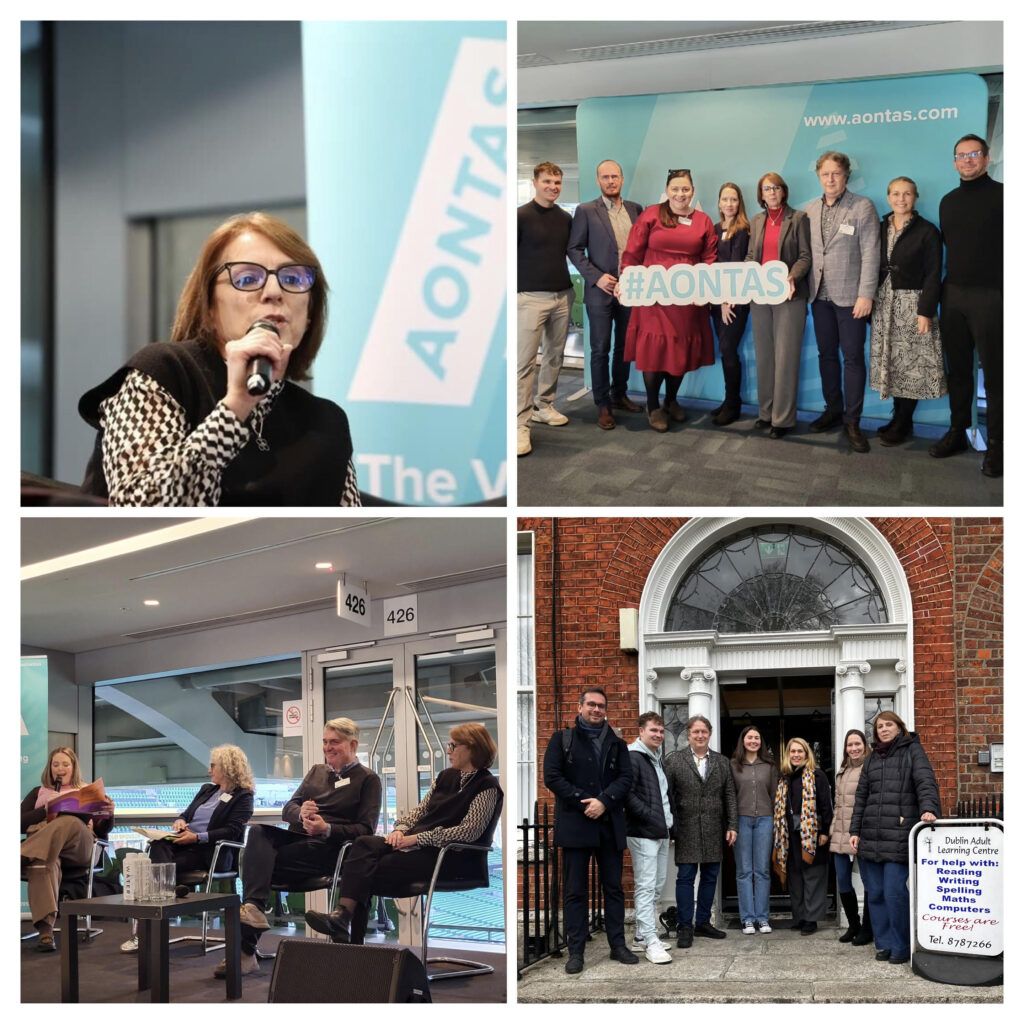
Ľubica Gállová, Lucia Bieliková, Tomáš Janči, and Monika Petlušová represented SIOV (State Institute of Vocational Education, Slovakia), Zuzana Valachová (Ministry of Education, Research, Development and Youth of the Slovak Republic), Marcel Lacko (Archdiocese Charity of Kosice), Peter Németh (Community Centre Platform), and Marek Chomanič (Roma Education Fund). The central point of the program was participation in the AONTAS 2025 Adult Education Summit, held at the Aviva Stadium in Dublin on November 19-20. As part of the summit, we also participated in a series of structured study visits with national stakeholders.
What the Summit Was About
The summit’s theme – “Connecting Communities for Collective Action” – brought together students, practitioners, community leaders, policymakers and academics from Ireland, the UK and across Europe to address widening social and economic disparities, polarisation and declining trust in institutions. AONTAS positioned adult and community learning as a practical engine of social cohesion: a way to reconnect, enable critical reflection and support people who conventional systems have left behind.
Two flagship releases framed the evidence base:
- Launch of Learner Voices Across Ireland: National FET Learner Forum Report (2024-2025), promoting lived experiences as a basis for policy and quality improvement.
- Launch of the peer-reviewed Adult Learner Journal (2025 edition), focusing on inclusion, equality and community practice.
Across plenaries, workshops and panels, several crosscutting themes stood out:
- Centring learner voice so feedback leads to visible change.
- Transformative education in times of polarisation – anchored in dignity, dialogue and democratic participation.
- Equality in apprenticeships and work-based learning, with fair access to opportunity.
- Partnerships that create flexible pathways between community learning, FET and higher education.
- Storytelling, antiracism and community organising as practical methods for connecting communities.
Keynotes by Dr Sharon Clancy (on reclaiming resilience and resistance through adult and community learning) and Professor Peter Mayo (on popular education in historical and contemporary practice) reinforced adult learning as both a public good and a democratic practice.
Our Participation and Insights
As a delegation, we participated over the two days primarily as engaged listeners. We were particularly interested in sessions that demonstrated:
- How student voice mechanisms are designed to translate learning into program and policy changes.
- Practical approaches to widening participation through flexible learning delivery, recognition of prior learning, and comprehensive support.
- The role of community-based learning in building belonging, civic engagement, and local resilience.
The programme consistently integrated research, policy, and lived experience, offering a coherent view of how system leadership and grassroots practice reinforce one another.
Ľubica Gállová’s Contribution
Ľubica Gállová, our Vice-Director for Lifelong Learning, participated in a panel discussion titled “Adult Education Beyond Borders: Partners from Across Europe,” led by Órla Barry from QQI. During the debate, Ľubica clearly explained Slovakia’s progress and priorities in adult education.
- Aligning European and national frameworks: She explained how tools such as the European Qualifications Framework and Europass inform national reforms in vocational education and training and adult learning, improving transparency, portability and progression for learners.
- Quality and accessibility: She highlighted an ESF-supported initiative, running from 2024, to introduce quality management into vocational education and training and adult learning, with an emphasis on flexibility and widening participation.
- Permeability and pathways: Ľubica highlighted modular, composable pathways and the recognition of prior learning to support the transition between non-formal, vocational and higher education without unnecessary barriers.
- She emphasised the importance of reaching out to adults who are not currently engaged in education. She also highlighted the need for partnerships with employers, local governments, and community organisations, in line with the summit’s goals.
- Evidence and Student Engagement: Following the launch of the Learner Voices initiative, she advocated for more systematic tools to collect student feedback and integrate insights into program design and decision-making.
Her contribution aligned with European good practice while acknowledging the work still needed to improve access and outcomes for marginalised groups.
The SOLAS Visit (20 November, post-morning program)
Following the morning summit programme on 20 November, we visited SOLAS for a briefing lasting approximately an hour. SOLAS is Ireland’s national agency for Further Education and Training (FET), providing strategic leadership, funding, research and performance oversight across 16 Education and Training Boards (ETBs). Its mission is to build a world-class FET system that develops the skills Ireland needs for the future and is accessible in every community.
The NALA Visit (18 November, arrivals program)
The delegation visited the NALA organisation, where they learned about the Irish system of supporting adult basic skills, particularly in the areas of literacy, digital competencies, and plain language. The discussion focused on strategies for motivating adult learners, creating user-friendly materials, and how NALA involves people with low literacy experience in policy-making and educational program development. We gained a comprehensive overview of their work in the field of basic skills development.
The DALC Visit (21 November, morning program)
The visit to the Dublin Adult Learning Centre (DALC) showcased a practical model of a community centre for adult education that combines basic education, family support (including childcare), and social counselling. A strong emphasis on 1:1 and small-group settings, social-practical learning, and certification brings visible progress for participants.
From the meetings and conferences, it emerged that there is a need to work more systematically on the development of basic skills for adults and young people (NEET), ideally through supplementary educational centres for adults, where basic skills are directly linked to VET education. The Irish experience shows that the lack of basic skills is a common reason for early dropout from VET courses and retraining.
A key inspiration is the concept of „plain language,“ which reduces communication barriers in accessing services. Within this concept, there is room for reflections on „plain Slovak“ or similar approaches in Slovakia.