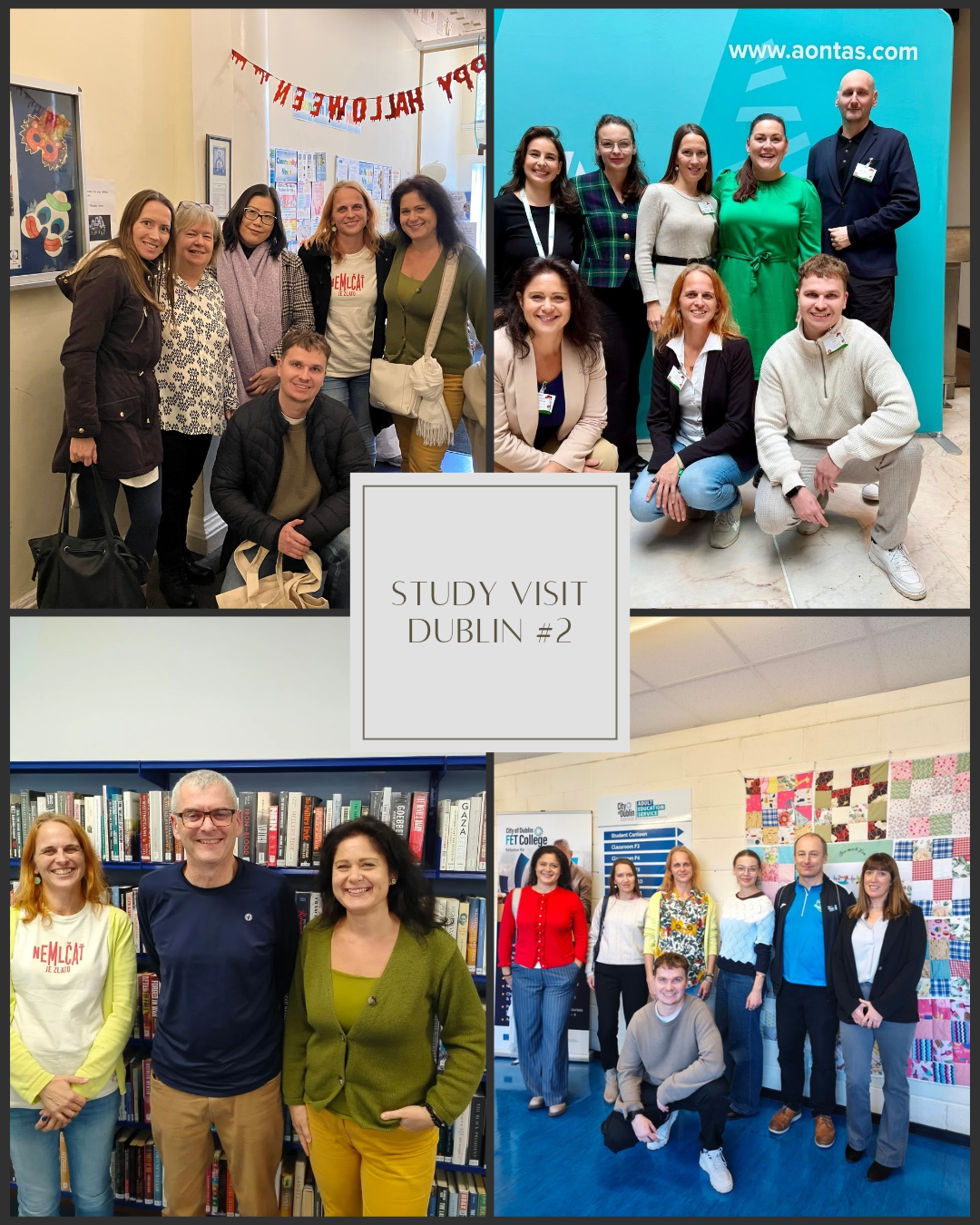
The National Coordinator for Adult Learning in Slovakia organised a second study visit to Dublin from 20 to 22 October 2026. The aim was to build on the previous visit and take it a step further. While last year we focused primarily on learning about the system and meeting key stakeholders at the national level, this time we focused mainly on how different approaches and measures are applied in practice. We sought to understand better how support for adults’ basic skills works in real-life settings, what results it delivers, and which experiences could inspire adult learning in Slovakia.
The delegation consisted of Lucia Bieliková and Tomáš Janči (ŠIOV – State Institute of Vocational Education), Michaela Mudroňová (Banská Bystrica Self-Governing Region Employment Agency), Jana Mojšová (People in Peril) and Mária Takáčová (Cesta von).
The central event on the programme was participation in the AONTAS 2026 Adult Education Summit, held on 21–22 October at the Radisson Blu Royal Hotel in Dublin.
After the official opening, the conference began with a panel discussion featuring colleagues from host organization AONTAS, who discussed data from local contexts on adult education, shared stories about their clients and outlined the future direction of their research activities.
This was followed by a second panel, which brought together representatives from frontline practice, academia and the nonprofit sector. The main topic of discussion was the voices that are not represented or considered in adult education in Ireland. The speakers shared experiences in educating excluded communities, prisoners, and people with disabilities. This section was followed by workshops addressing topics such as the future of research in this field, networking, and capacity building. The workshop insights were recorded in writing, and the findings should be shared with us soon. The conference day concluded with Professor Lyn Tett from the UK. In her address, she highlighted the need to organise similar events and emphasised that research in this field cannot be conducted without hands-on experience.
The most important thing said at the conference, and what continues to resonate with us, was “Pay people”. For them, it is only natural that people receive financial compensation for participating in education. They recognise that adult education costs not only time, but money too. People must pay for travel and food, while also giving up time they could otherwise spend working or doing a part-time job. This creates a vicious circle. To gain better skills and find better work, they need to pursue education. But to cover their basic needs, they need money today. Sometimes, therefore, motivation alone is not enough. Even a financial contribution that may seem unusual in our context can determine whether someone participates in education at all.
In addition to participating in the summit, the programme also included a series of structured study visits focusing on how Ireland’s adult education system works and how it is applied in practice.
Visit to Ozanam House (20 October 2026)
After arriving in Dublin, our first stop was the Ozanam House community centre, where we met Nan Jiang (Centre Administrator) and Geraldine O’Driscoll (Centre Manager), who told us how the centre operates, its activities, and its approach to supporting the local community.
It is a local community centre offering a wide range of courses, programmes and support activities for people of all ages. It is not intended exclusively for any group of people but serves as a space for the whole community. Its welcoming and inclusive approach is evident, as is the environment where everyone can feel accepted. A major bonus is the support provided to parents with children, who are cared for while activities are taking place, allowing parents to take part in various courses and other centre activities.
What particularly impressed us at Ozanam House was its open and respectful approach to people, regardless of their education or life experience. The centre creates a safe environment where no one feels embarrassed about lacking certain skills or needing to learn something new. Mutual support, trust and a sense that everyone is part of the community are important here. We also see this approach as an inspiration for adult education in Slovakia.
Visit to Ballymun Library (20 October 2026)
Michaela Mudroňová and Jana Mojšová visited Ballymun Library, where they met with Peter O’Reilly (Senior Librarian). At the same time, AONTAS organised an informal meeting of national coordinators.
Last year, the National Adult Education Coordinator ran a campaign on innovative learning environments in Slovakia, and libraries are one example. Today, libraries are no longer just places to borrow books; they are becoming spaces for learning, creating, meeting, and developing various skills. The library in Ballymun, Ireland, is one of them.
Visit to City of Dublin ETB Adult Education Service (22 October 2026)
We set aside the final day of the study visit exclusively for a meeting with Andrew Connolly, an expert in literacy and plain language, who welcomed us at the City of Dublin ETB Adult Education Service in Ballymun.
This very place offers free English as a Foreign Language classes and free courses for adults focused on developing basic skills. The FET College certificate, of which the centre is a part, is recognised by employers without any problems.
In his work, Andrew Connolly focuses on making information and services accessible and understandable to everyone, including people who have difficulty reading and understanding text. As a member of the Dublin Regional Literacy Coalition, he also supports cooperation between organisations and the development of programmes that help people improve their skills and navigate everyday life more easily.
Ireland has once again shown us that there is plenty to inspire us in adult education. This is not just about specific programmes or examples of good practice, but also about the overall approach to people and education. Above all, it is about recognising that many things that work there are not impossible here either and could gradually be put into practice.
They say film sequels are never as good as the first part. Our Study Visit Dublin #2, however, proves that this need not be the case. The second visit brought us just as much inspiration, new knowledge and opportunities to meet people as the first. We returned home with plenty of ideas and wondered whether there would be any follow-up.